
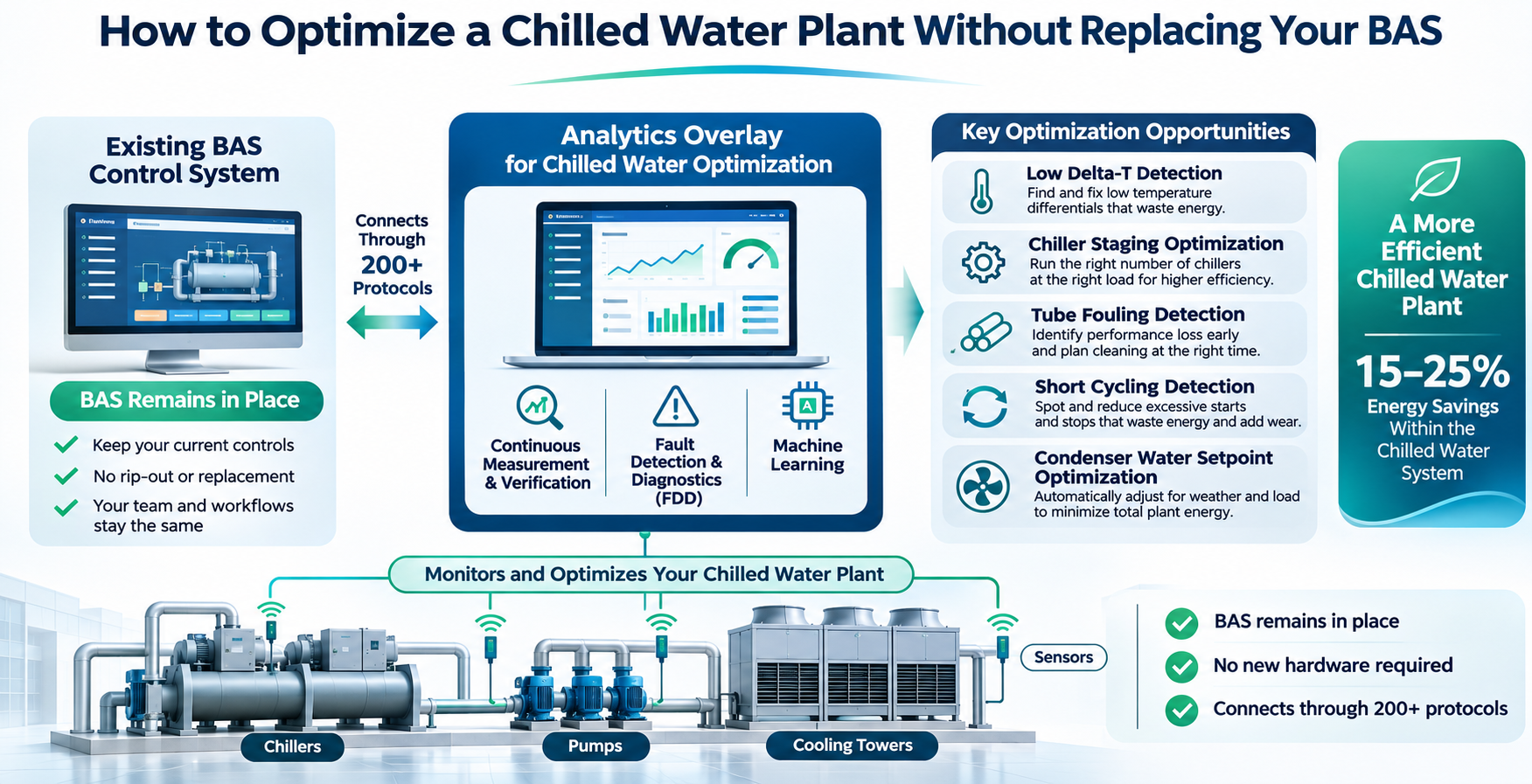
Your building automation system (BAS) may be doing exactly what it was designed to do: controlling chillers, pumps and cooling towers while maintaining required building conditions. But a plant that operates without alarms is not necessarily operating at peak efficiency.
Chilled water plant optimization uses operating data, fault detection and analytics to identify wasted energy and improve how equipment works together. In many facilities, an analytics overlay can connect to the existing BAS without replacing the controls. The goal is simple: deliver the same cooling with less energy.
Question to consider: If someone asked for your plant’s current kW per ton—and how it compared with last Tuesday at a similar load—could your team answer?
A BAS executes sequences, maintains setpoints and responds to alarms. It may not continuously evaluate whether the whole plant is running at its most efficient operating point as weather, load and equipment performance change.
Five problems can quietly increase chilled water plant energy consumption:
For example, two chillers may run at partial load when one could serve the demand more efficiently. Both units can be functioning normally while the plant uses more electricity than necessary.
Which of these conditions could persist in your plant for weeks without anyone noticing?
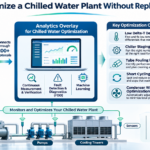
An analytics overlay uses available data from the existing BAS to calculate plant performance, identify abnormal patterns and prioritize corrective actions. The BAS continues to operate the equipment. Integration and instrumentation requirements vary by site, so a plant assessment should confirm what is available.
Machine learning can help identify relationships among cooling load, weather, equipment combinations and setpoints that fixed sequences may miss. Instead of optimizing each chiller independently, the focus is on the combined energy used by chillers, pumps and cooling towers.
Engineers review recommendations and determine appropriate changes. Continuous measurement and verification then compare performance against a baseline adjusted for load and operating conditions.
Question to consider: Can you show, using your own plant data, what a recent staging or setpoint adjustment actually saved?
A 15–25% reduction in energy consumption within the chilled water system is a potential planning range, not a guaranteed result. Actual savings depend on the plant’s current condition, existing controls, operating patterns and the improvements implemented. This percentage does not represent a reduction in total facility energy use.
Many opportunities involve control adjustments, improved sequencing and maintenance actions rather than replacing the BAS. However, some findings may identify instrumentation, equipment or capital improvements worth evaluating.
The most useful measure of progress is not simply fewer alarms. It is verified improvement in plant kW per ton and energy consumption under comparable operating conditions.
It is the ongoing measurement and improvement of how chillers, pumps and cooling towers operate together to deliver required cooling with less energy.
Often, yes. An analytics overlay can use existing BAS data and preserve established controls, subject to site-specific integration and instrumentation requirements.
Common causes include excess flow, improperly operating valves, coil performance problems and control strategies that no longer match demand.
Track plant kW per ton and total energy against an appropriate baseline adjusted for cooling load and operating conditions, then validate results over time.
FacilityConneX can help you identify, prioritize, and solve problems before they become risks. Want help choosing the right system, or need a second opinion on your current setup? We’re just a message away. Contact FacilityConneX at info@facilityconnex.com to learn how secure cloud-based solutions can provide complete data visibility without operational disruption.
FacilityConneX can help you identify, prioritize, and solve problems before they become risks. Want help choosing the right system, or need a second opinion on your current setup? We’re just a message away. Contact FacilityConneX at info@facilityconnex.com to learn how secure cloud-based solutions can provide complete data visibility without operational disruption.
Let’s take steps towards optimizing your facility today.